If you wish to add space for storing to a Nintendo Change, GoPro or Raspberry Pi, you want a microSD card. However whereas a number of playing cards will probably be quick sufficient for many use circumstances, some cheap choices will carry out higher than others. We just lately put a dozen fashions by means of a variety of benchmark exams that will help you discover one of the best microSD playing cards on your wants.
What to search for in a microSD card
Capability
The very first thing to determine when shopping for a microSD card is how a lot house you want. Fashionable playing cards are normally accessible in sizes starting from 32GB to 512GB, whereas a handful provide 1TB fashions as effectively. 2TB playing cards are theoretically potential however still in the prototype stage.
For many, a 128GB or 256GB mannequin needs to be the candy spot between worth and capability. However if you happen to want extra room – say, for stashing a bunch of video games on a Steam Deck – a 512GB card might make extra sense and infrequently supplies a greater cost-per-GB ratio. As of late, you will discover an honest 128GB card for round $15 or much less, an honest 256GB card for lower than $30 and (with sales) an honest 512GB card could possibly be as little as $40 (although most price nearer to $50 or $60). There’s a starker improve once you go as much as 1TB playing cards, which generally price round $100.
Observe {that a} microSD card’s efficiency might differ relying on what capability you purchase. SanDisk says its 128GB Extreme card delivers sequential write speeds as much as 90 MB/s, for instance, whereas the higher-capacity fashions in the identical line provide as much as 130 MB/s.
After we speak about microSD playing cards at present, we normally confer with playing cards that use the microSDXC (eXtended Capacity) standard, which have a capability between 32GB and 2TB. Your machine must assist this for it to work with a microSDXC card. It will virtually by no means be a problem lately, however some older gadgets (a Nintendo 3DS as an example) are solely appropriate with microSDHC (Excessive Capability) playing cards, which vary from 2GB to 32GB.
Learn and write speeds
MicroSD playing cards are primarily judged on their learn and write speeds, that are normally measured in megabytes per second (MB/s). Typically talking, most microSD playing cards have sooner learn speeds than write speeds. These metrics can then be damaged down into sequential and random efficiency. Sequential learn and write speeds matter once you’re attempting to entry or save lengthy, fixed streams of knowledge, akin to opening a big video or copying an enormous batch of recordsdata from a PC. If you wish to use a microSD card for media storage, that is notably vital.
Random efficiency, in the meantime, is about how rapidly a card can learn and write small recordsdata scattered all through the machine. Since random learn/write speeds are a lot decrease than sequential ones, storage machine makers have a tendency to not promote them as loudly. However they’re vital if you happen to use a card with a gaming machine or a single-board pc just like the Raspberry Pi, the place it usually has to quickly save and entry small bits of knowledge in random places.
SD Affiliation
Velocity scores
For those who take a look at a microSD card, you’ll see a buffet of numbers, letters and symbols. Most of those confer with the cardboard’s speed class and efficiency scores, that are decided by the SD Association.
A card’s Video Velocity Class, or V-rating, particulars its minimal sequential write pace, which is particularly vital when recording video from a digicam. It ranges from V6 to V90. A lot of the playing cards we examined had a V30 score, so that they have a sequential write pace of at the very least 30 MB/s. This needs to be sufficient to assist as much as 4K video at decrease bitrates. Increased-rated V60 and V90 playing cards are normally higher for capturing 8K, however they arrive at a a lot greater price.
The UHS Velocity Class, or U-rating, additionally refers to a card’s minimal sequential write pace. It is available in two varieties: U3, which mandates a minimal of 30 MB/s, and U1, which is rated for 10 MB/s.
The older Velocity Class score overlaps with the opposite two methods. It’s signified by a C image and goes from Class 2 to Class 10, with the quantity (once more) indicating minimal sequential write pace. This score is much less related these days, however you should still see a “C10” emblem on some playing cards.
The Software Efficiency spec, marked by an An emblem, is an indicator of random learn/write speeds. That is measured in IOPS, or enter/output operations per second, relatively than MB/s. There are two classes right here: A1 playing cards provide a minimal random learn pace of 1,500 IOPS and a minimal random write pace of 500 IOPS, whereas A2 playing cards bump these as much as 4,000 IOPS and a pair of,000 IOPS, respectively. Each scores additionally assure sequential write speeds of at the very least 10 MB/s.
Most individuals ought to search for a card with V30, U3 and A2 scores. It’s completely potential to get a strong card with out these: A U1 card could be value it if you happen to simply want an affordable possibility with a excessive capability to carry recordsdata, for instance. V60 and V90 playing cards are value a glance if you happen to’re severe about capturing high-resolution photographs and video as effectively. However usually talking, playing cards with the certifications above ought to present one of the best mix of worth and efficiency at present.
It’s vital to emphasise that these scores are baselines. Many V30 playing cards provide considerably greater write speeds than 30 MB/s, as an example, and a few A1 playing cards can outperform some A2 fashions in observe. The speeds marketed by producers aren’t all the time 100% correct, both: Generally the cardboard will probably be slower in real-world use, different instances it could truly be a bit sooner.
UHS bus speeds
The opposite spec to notice is the cardboard’s bus interface. Most microSD playing cards accessible at present are UHS-I, which have a theoretical most pace of 104 MB/s. There are additionally UHS-II playing cards, which have an additional row of pins on the again and might attain as much as 312 MB/s. (A more moderen UHS-III normal exists as effectively however hasn’t seen large adoption simply but.) These are labeled on the cardboard with a Roman numeral I or II.
Absolutely the quickest microSD playing cards proper now are UHS-II playing cards, and so they’re normally those with V60 or V90 scores. For those who shoot numerous 4K to 8K video or regularly use burst mode to seize extremely high-res photographs, the efficiency positive factors of a great UHS-II card can prevent time.
However these are way more costly than UHS-I playing cards: This 128GB model from ProGrade Digital, for instance, is a relative cut price at $55. You want a tool that’s appropriate with the UHS-II interface to see any advantages, too, and as we had been placing this information collectively, inventory for UHS-II playing cards was spotty. For now, the upper speeds aren’t well worth the worth premium for the overwhelming majority of individuals, so we largely caught to UHS-I choices.
Kris Naudus / Engadget
A notice on card readers, the Nintendo Change and Steam Deck
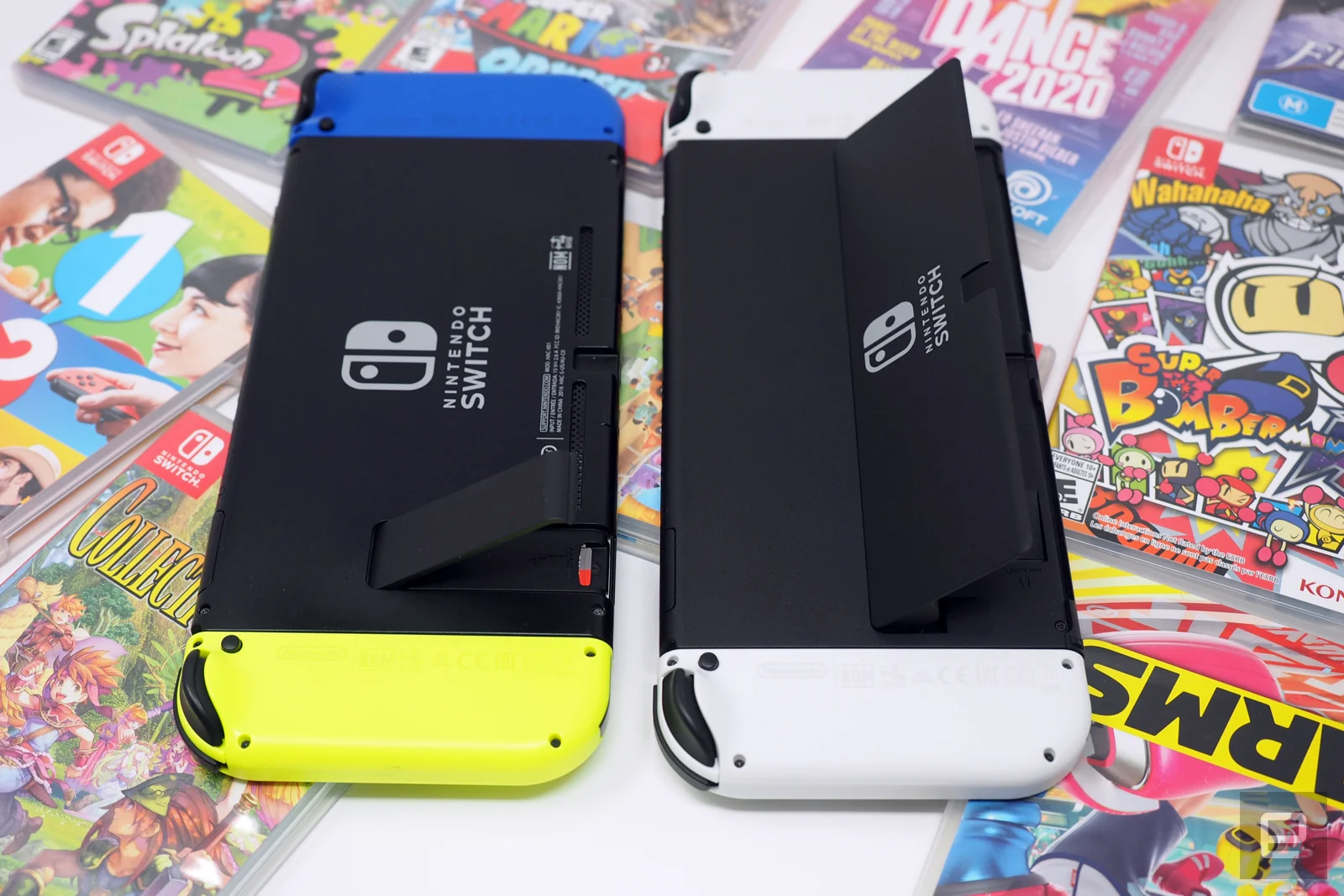
Whereas the UHS-I spec has a theoretical most of 104 MB/s, some UHS-I playing cards can exceed that pace by means of proprietary extensions. You want a appropriate card reader and host machine to make the most of that further efficiency, although. For those who discover a UHS-I card promoting speeds greater than 104 MB/s, that is what’s happening. You may see these limits in motion with a Nintendo Change or Steam Deck: Both of those gaming gadgets assist the UHS-I interface and don’t transcend its official pace, flattening any sequential positive factors some playing cards might have elsewhere. The broader takeaway: Your microSD card will solely be as quick because the slowest hyperlink in your chain.
Guarantee
Many microSD playing cards are designed to be sturdy, with safety from water, excessive temperatures, X-rays and drops. Nonetheless, in case of disaster, an extended guarantee is all the time good to have. Many producers provide lifetime restricted warranties, although we’ve seen that “endurance” playing cards marketed to resist extra hours of writing are normally lined for a a lot shorter time frame.
Avoiding counterfeits
The reminiscence card market has had a selected downside with scammers promoting faux merchandise. To protect towards this, solely purchase from a identified model and a good retailer akin to Greatest Purchase, B&H Photograph or Adorama. For those who store at Amazon, solely purchase if the shipper and vendor is Amazon.com. (Although a handful of customers have reported receiving counterfeits even from Amazon straight previously.) Keep in mind: If a worth appears too good to be true, it in all probability is. Be cautious of any retailer providing considerably a lower cost than others.
When you obtain a card, examine its packaging for any irregularities. You may run benchmark exams like CrystalDiskMark or BlackMagic Disk Speed Test to confirm its speeds aren’t drastically decrease than what’s marketed (or potential, given its specs). You can too use software program that’s designed to confirm the true capability and efficiency of your card, akin to H2testw and FakeFlashTest.
How we examined
We put 12 microSD playing cards by means of a sequence of exams to confirm their sequential and random efficiency. These included benchmarks like CrystalDiskMark, BlackMagic Disk Speed Test, ATTO Disk Benchmark and AJA System Test, in addition to just a few “real-world” exams. We copied and pasted a small folder of photographs about 1.15GB in measurement to and from every card, then did the identical with a bigger 12.2GB folder containing a number of file sorts and subfolders, timing the method every time. We additionally checked how every card carried out on the Steam Deck, downloading video games of various sizes – together with Stardew Valley, Aperture Desk Job, Metal Gear Rising: Revengeance and Apex Legends – then timing how lengthy it took to launch every recreation and cargo save recordsdata.
We used a Kingston USB 3.2 UHS-II reader to check every card on each Home windows 11 and macOS Ventura. For the previous, we used an Alienware gaming PC with an Intel Core i9-10900F, Nvidia GeForce RTX 3080 GPU, 32GB of RAM and a 1TB SSD. For the latter, we used a 2021 16-inch MacBook Professional with an Apple M1 Professional chip, 16GB of RAM and a 512GB SSD. To make use of our card reader on the MacBook, we used Apple’s USB-C Digital AV Multiport Adapter.
We examined the 128GB model of every card wherever potential, although for a few playing cards – the SanDisk Excessive and Samsung Professional Plus – we had been solely in a position to check their 256GB fashions. We additionally reformatted every card earlier than testing with the SD Affiliation’s Memory Card Formatter tool.
Greatest for many: Samsung Professional Plus
The Samsung Pro Plus supplied nearly one of the best sequential write efficiency of the playing cards we examined (round 130 MB/s in CrystalDiskMark) and topped all of them by way of random learn/write speeds, so it ought to work nice whether or not you’re shopping for for a digicam, pill or gaming handheld. Unsurprisingly, it has all of the requisite scores: U3, V30 and A2. Its sequential learn efficiency isn’t fairly as fast as a few of our alternate picks under, but it surely’s not far behind. In our massive file switch check, as an example, it was solely 4 seconds off the quickest fashions.
The Professional Plus initially began at $19 for 128GB, $30 for 256GB and $60 for 512GB, however latest gross sales have introduced these fashions as little as $12, $20 and $35, respectively. When it’s that low cost, the Professional Plus makes most competing microSD playing cards irrelevant. Samsung additionally sells the cardboard with a USB reader that’ll assist it attain its most speeds for just a few {dollars} extra. Both approach, the cardboard comes with a 10-year restricted guarantee.
For those who decide to purchase the Professional Plus, be sure you get the latest-generation mannequin, which Samsung launched in April 2023. For the time being, the corporate continues to be promoting the prior iteration of the Professional Plus, which appears an identical however isn’t as fast, particularly in the case of random learn/write speeds. (Search for the mannequin with sequential learn speeds rated at 180 MB/s and sequential write speeds rated at 130 MB/s.) We examined the 256GB model of the Professional Plus on account of inventory points with the 128GB mannequin on the time of testing, however this shouldn’t have a serious influence on real-world efficiency, as Samsung charges each playing cards identically.
Runner up: Kingston Canvas Go Plus
If the Samsung Professional Plus ever turns into unavailable, the Kingston Canvas Go Plus is a powerful different. It is a U3-, V30- and A2-rated card backed by a lifetime restricted guarantee. It delivered the best sequential learn speeds of any card we examined throughout CrystalDiskMark, ATTO and the BlackMagic Disk Velocity Take a look at, simply edging out SanDisk’s Excessive and Nintendo Change-branded playing cards. It successfully tied with these two playing cards in our massive file switch check. Its sequential write speeds (simply over 100 MB/s on CrystalDiskMark) are the place it lags behind the Professional Plus, however they need to nonetheless be fast sufficient for a lot of makes use of. Its random learn/write speeds had been solely bested by Samsung’s card, too, so it’s nonetheless a great possibility for apps and video games. It’s exhausting to justify if you happen to see it priced greater than the Professional Plus, nevertheless.
Greatest worth: Samsung Evo Choose
The Samsung Evo Select is a step behind our high picks, notably in the case of sequential write speeds (slightly below 70 MB/s on CrystalDiskMark), so it’s not supreme for a digicam. Nonetheless, it’s completely usable for a lot of use circumstances, and we have seen its 128GB, 256GB and 512GB fashions fall as little as $12, $18 and $35, respectively, previously. All of these are about on par with the SanDisk Ultra, a regularly really helpful cheapo card, regardless of the Evo Choose having greater V30, U3 and A2 scores. The Professional Plus has been accessible for round these costs, too, however the Evo Choose tends to sit down there extra often.
One other good possibility: SanDisk microSDXC Card for Nintendo Change
The SanDisk microSDXC Card for Nintendo Switch is one other worthwhile possibility if you happen to ever see it accessible for lower than the Professional Plus and Canvas Go Plus. Its sequential learn speeds had been about the identical because the Kingston card in our benchmarks, however its sequential writes had been barely slower (and farther behind the Professional Plus). Its random learn/writes had been a step behind in accordance with CrystalDiskMark, as effectively. The 128GB version of this card is normally priced round $20, however these days the 512GB version has gone for $10 or so lower than the Canvas Go Plus. SanDisk backs the cardboard with a lifetime guarantee, too. Observe that we examined the Apex Legends model of the 128GB card. SanDisk additionally sells a Super Mario model, however we will’t converse as to if that one performs any in a different way.
One other good possibility: Lexar Skilled 1066x
Equally, the Lexar Professional 1066x is an honest different to the Professional Plus if you happen to see it cheaper. It’s one other V30, U3 and A2 card, and like Samsung’s card, its sequential write speeds had been a bit sooner than the Canvas Go Plus and SanDisk Change card in our benchmarks. These write speeds weren’t as fast as Professional Plus, and its sequential reads trailed all three playing cards. Random learn/writes additionally lagged behind the Professional Plus and Canvas Go Plus, and we seen its speeds peak and dip extra noticeably in our file switch check. Nonetheless, it’s not gradual, so relying on its worth, it could be a great cut price if you need higher write speeds than the Kingston card can provide. It additionally comes with a lifetime restricted guarantee.
Different notable microSD playing cards
Photograph by Jeff Dunn / Engadget
We didn’t use it ourselves, however if you happen to’re prepared to pay for a extra highly effective UHS-II card constructed for heavy-duty video recording, the Delkin Devices Power has tested well elsewhere and will ship considerably sooner sequential write speeds than our picks above. It’s one of many few UHS-II playing cards we might truly discover in inventory, but it surely prices a ton, normally beginning at $55 for simply 32GB.
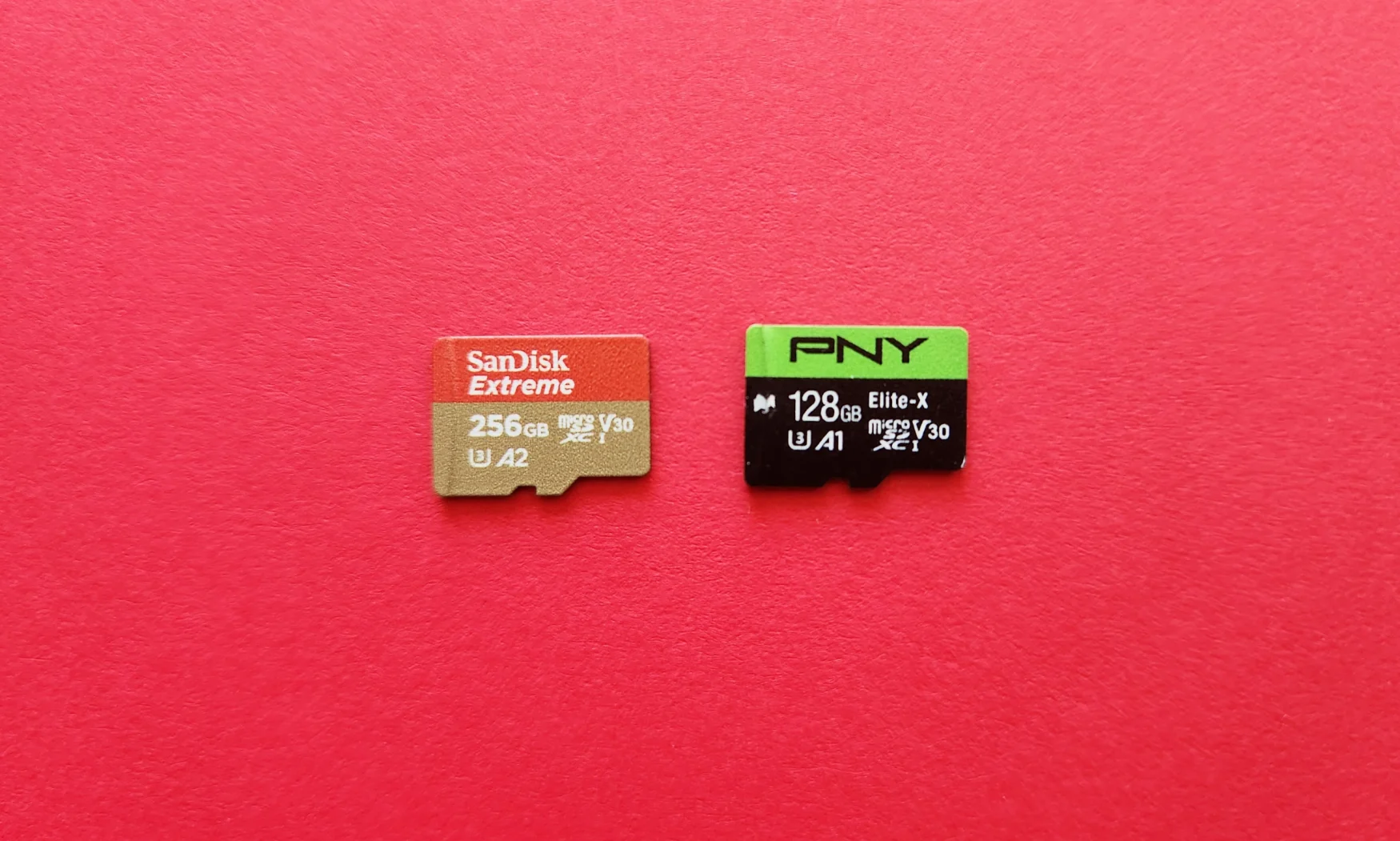
The SanDisk Extreme successfully matched the Professional Plus in just a few of our sequential write exams and delivered sequential reads about on par with the Canvas Go Plus, however that was partly on account of us solely having the ability to safe the cardboard’s 256GB mannequin, which is higher-rated than the 128GB model. Its random efficiency was effectively behind the Samsung and Kingston playing cards, too, and it is usually price extra as of late. For those who see it on sale from a good vendor, nevertheless, it’s one other high quality possibility.
The SanDisk Extreme Pro, in the meantime, is rated for even greater speeds (as much as 200 MB/s sequential reads), but it surely seems to be both unavailable at most trusted retailers or priced considerably greater as of this writing.
The PNY Elite-X wasn’t far off the random learn/write efficiency of the Professional Plus and Canvas Go Plus in CrystalDiskMark, and it usually goes for affordable, but it surely was effectively behind in our sequential exams.
Trending Merchandise